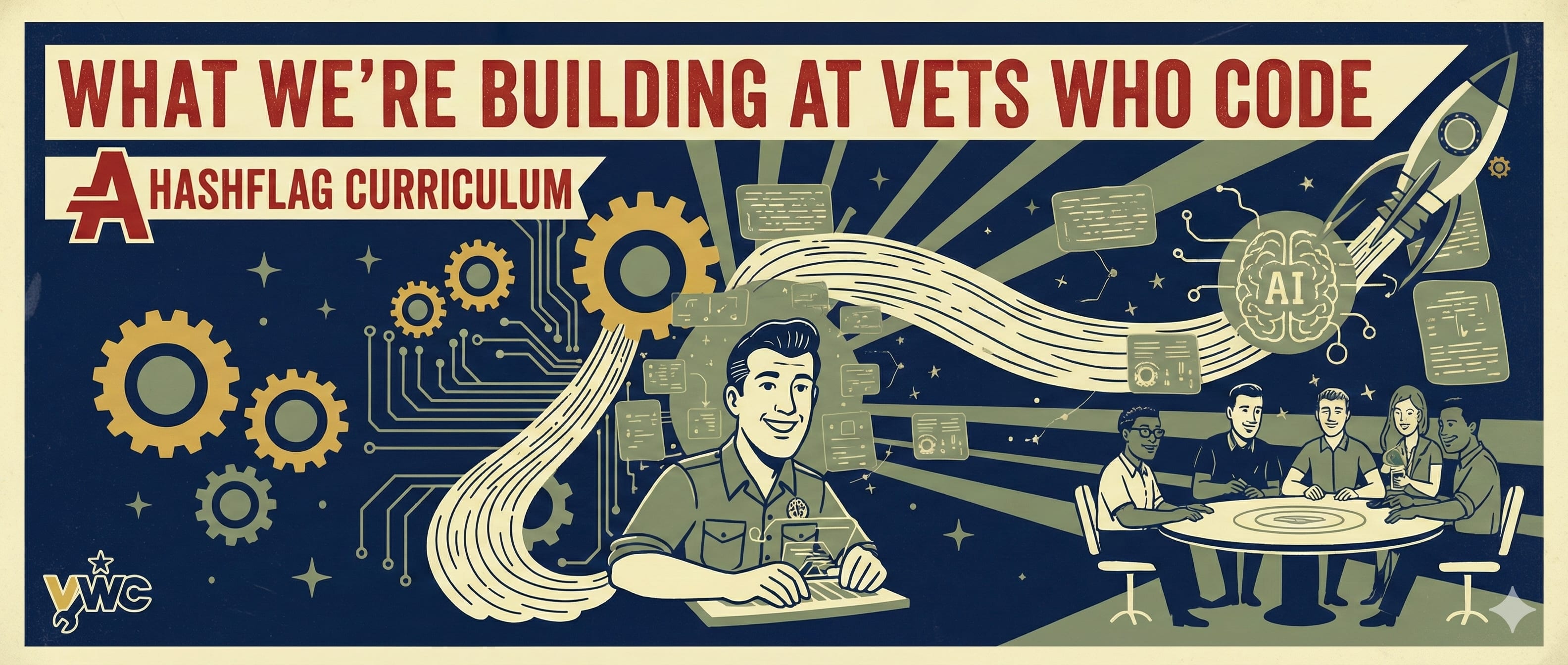
After a decade of training veterans in software engineering, we've rebuilt our curriculum from the ground up. The result is the Hashflag curriculum—a program designed for where the industry is headed, not where it was. This is the first time we've added a new language to our stack in eight years.
Why We Made This Change
The industry shifted. AI isn't a specialization anymore—it's becoming foundational to how software gets built. Companies need engineers who can architect intelligent systems and ship them to production. Not people who use AI tools, but people who build with them.
We saw that shift coming, and we spent two years rebuilding our program to meet it. Our graduates deserve to enter the market with skills that matter now, not skills that mattered five years ago.
How the Program Works
We built this program around how veterans actually learn—clear objectives, real accountability, and meaningful work:
It fits your life. This is a program built for people with jobs and families. 10-20 hours a week, on your schedule. No cost to you.
The work is real. You push code directly to the Vets Who Code production platforms. That means commits to a live codebase that people visit everyday—not tutorial projects.
We teach adaptability. Frameworks change. Languages evolve. The skill that outlasts everything is the ability to pick up new technology quickly. We prioritize that from day one.
What We Prioritize
The curriculum itself came from working with recruiters and external data provided from one of the largest job data taxonomies, then working backwards to identify what actually mattered. We validated 128 specific skills against billions of job postings. It's the most data-driven program we've ever built. People tend to treat AI as the star, but it's really just another layer in the stack—powerful only when the foundation beneath it is solid. A few principles guide the program:
Fundamentals first. Before you touch AI, you need to know how to code. You write every line by hand until it's second nature. There are no shortcuts here.
Rigor matters. Production AI systems are complex. Loose data validation breaks systems. We teach tight practices from the start.
User experience is engineering. Modern AI applications stream responses in real time. We teach that pattern because it's what users expect.
New testing patterns. Traditional testing strategies don't cover LLM output evaluation. We teach approaches designed for non-deterministic systems.
Observability. You can't improve what you can't measure. When something goes wrong in production, you need to understand why.
Why We're Not Publishing It
We've always shared our educational findings openly. Curriculum documents, training methods, lessons learned—all of it. That's what nonprofits do.
What happens next is predictable: for-profit bootcamps take the work, package it, sell it, and never mention where it came from. No credit, no attribution. Just business.
We're not doing that this time. The Hashflag curriculum stays internal. Our veterans get access to it. The organizations that have supported our mission get to see the results. Everyone else can watch from the outside.
Besides—bootcamps couldn't run this program if they wanted to. They don't trust their students with production code. We do. Our troops push commits to an application that generates real donations and revenue. That's not a model you can copy from a curriculum document.
This isn't bitterness. It's just learning from experience.
Why Veterans
Learning to code while working full-time and raising a family is hard.
The people who make it aren't the ones with the most free time. They're the ones who refuse to quit.
That's military training. That's the advantage.
Military service teaches you how to learn complex systems under pressure, how to execute when you're tired, and how to keep going when things get difficult. That translates directly to this work.
Where We Are
Our graduates are at Microsoft, Google, Home Depot, and dozens of other companies.
If you're a veteran interested in software engineering, we'd like to hear from you.
Jerome Hardaway is the Executive Director of Vets Who Code, a 501(c)(3) nonprofit that has trained over 300 veterans in software engineering.
Support Vets Who Code
If this story resonates with you, consider supporting Vets Who Code to help more veterans transition into successful tech careers. Donate now to make a significant impact. You can also sponsor us on GitHub to get technical updates and support our mission. Together, we can make a difference.