
Labor Day is right around the corner, so if you wore a uniform and you're aiming for a software engineering role, that gives you about two weeks to make your experience legible to the market.
I’m writing this first for our troops at Vets Who Code, but the principles apply to any early-career builder trying to break through the noise. This is a ten-day sprint. Treat it like a high-density training block: do the reps, put in the work, and leave a little breathing room for when life happens.
I'm speaking to you from the unincentivized middle. I don't get a kickback for telling you this, but as an AI and LLM manager who actually reviews pull requests and trains engineers, I need to be honest with you about what’s happening in the market right now.
The September Surge is still real, it just got picky.
The seasonal rhythm where companies drop Q1 budgets or scramble to burn Q4 headcount didn't disappear, it narrowed. Companies are still hiring hard, but they're hiring for a specific profile and quietly passing on everything else.
The numbers tell the story. Postings that ask for AI skills are paying a premium—around 28% more, according to Lightcast data. But here is the kicker: in those same AI-enabled roles, the most requested skills aren't LangChain or vector databases, they are communication, problem-solving, and judgment.
Tool fluency is table stakes, but judgment is the premium.
The Ground Moved (And AI Ate the Bottom Layer)
A lot of career advice from 2022 is now actively harmful.
Think of every job as two layers. The bottom layer is routine execution—report formatting, boilerplate code, ticket triage. The top layer is judgment—deciding what's worth doing, verifying the output, and knowing when a system is hallucinating.
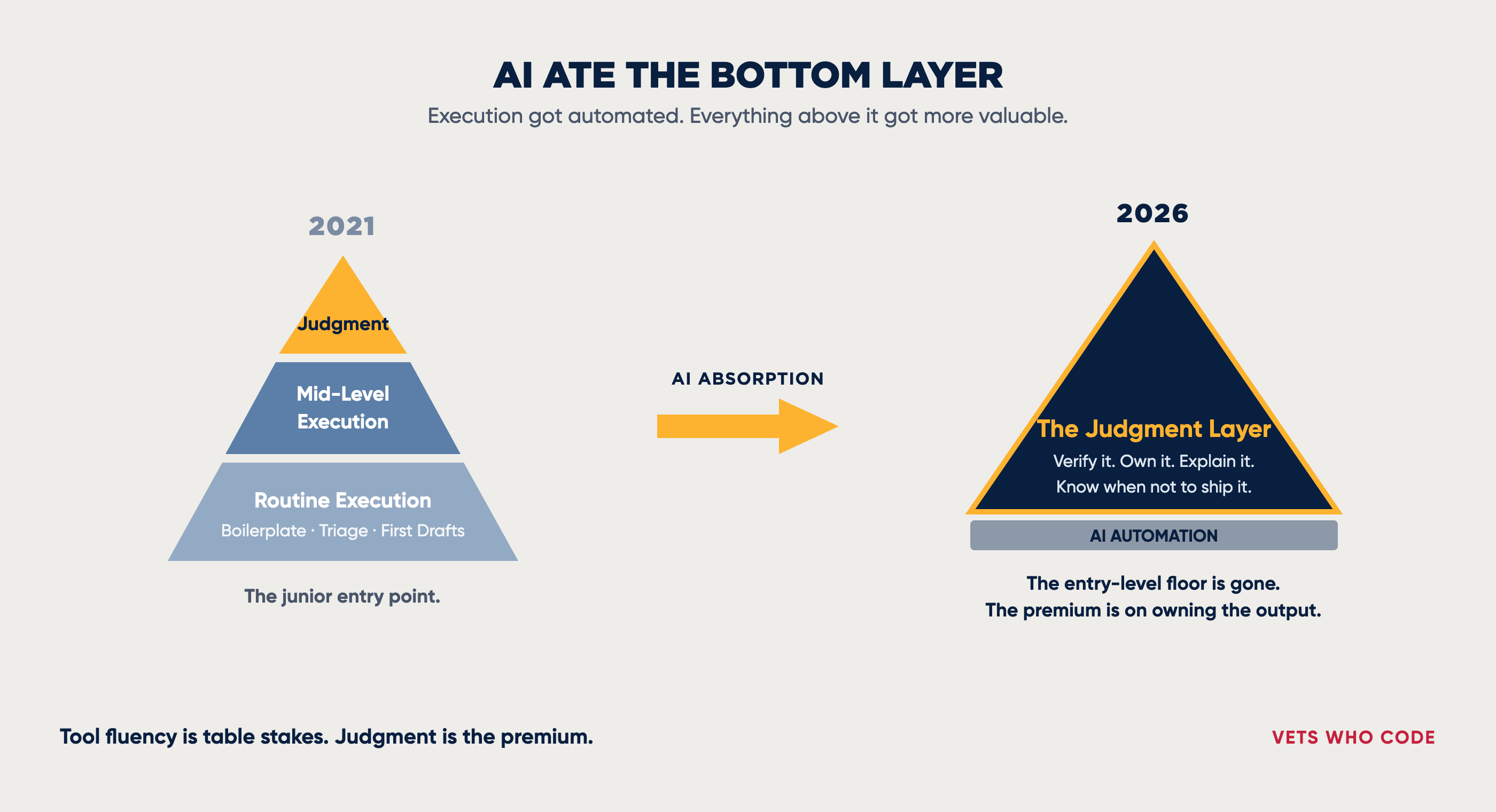
AI ate the bottom layer. Companies aren't necessarily doing mass layoffs, they are just practicing "hiring avoidance." When a junior seat opens, they don't backfill it, because a mid-level engineer with an LLM and good judgment can now do the work of three 2021-era juniors.
Here is why you need to sit up straight: That judgment layer is exactly what you brought home from the military.
You’ve maintained multi-million-dollar equipment on a flightline, owned the readiness of your troops, and worked problems with incomplete information, hard deadlines, and real consequences for being wrong. You've made the call when the checklist ran out.
That is the judgment layer. It is fully formed, built under pressure, and the market just stopped subsidizing it for civilians. The execution layer (Python, FastAPI, PostgreSQL) is teachable. We can fast-track execution, but we cannot fast-track judgment.
This sprint is about making that judgment legible.
The Sprint
Ten blocks, one per day, ninety minutes each. Do them in order.
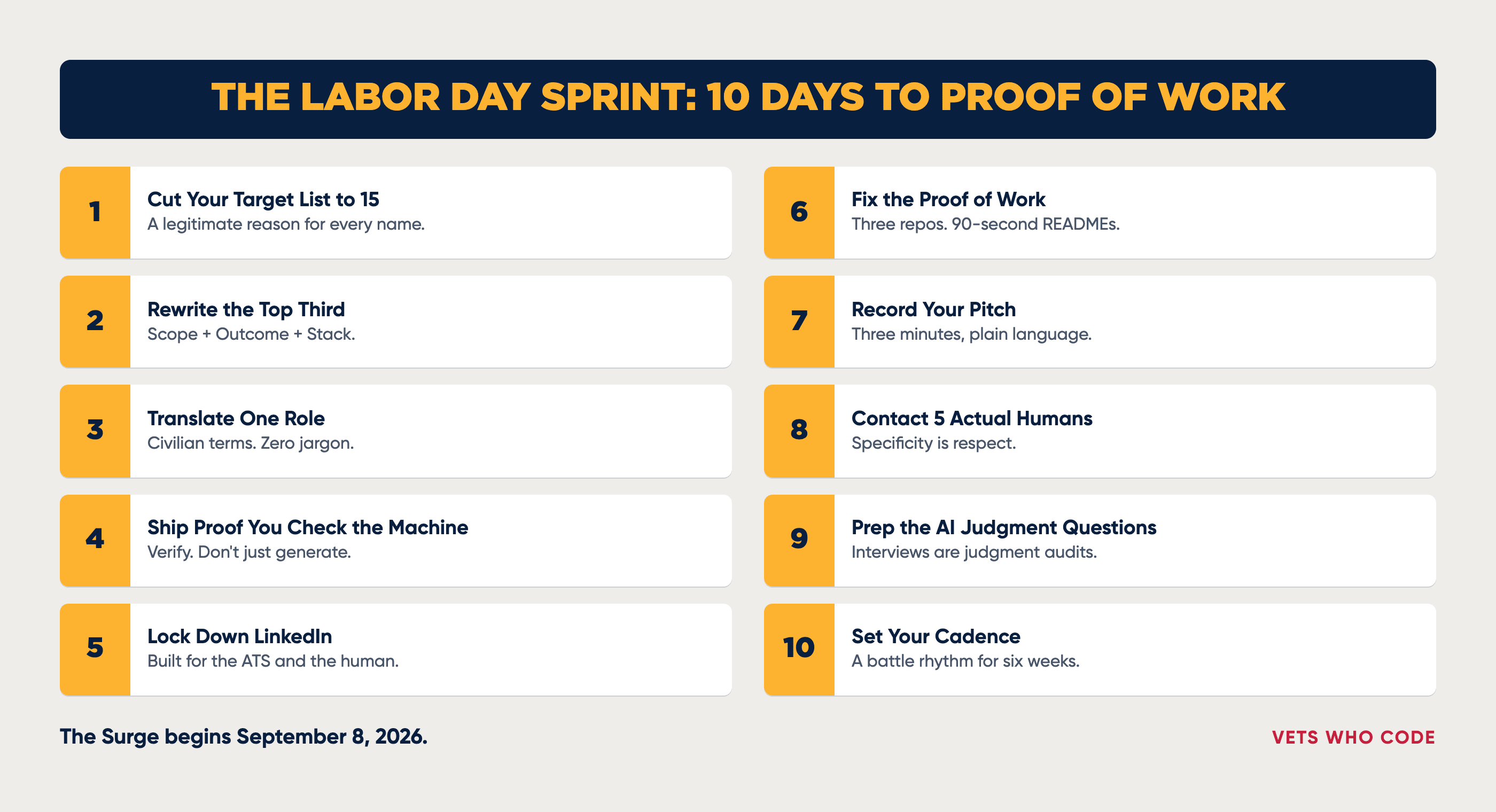
Day 1: Cut your target list to 15 companies
The spray-and-pray approach is dead. Pick 15 organizations you have a legitimate reason to apply to, whether they have a real veteran hiring pipeline, they are a federal contractor where your clearance is leverage, or they sit in your specific domain (healthcare, logistics, defense). "They are hiring" is not a reason.
Day 2: Rewrite the top third of your resume
Nobody reads the bottom of a resume on the first pass, so delete the fluffy objective statement. You aren't asking for a favor, you are offering scope and judgment. Use this formula: Scope + Outcome + Stack.
Example: Led a 12-person maintenance section responsible for $40M in equipment at 98% operational readiness. Now building production AI systems in Python and FastAPI—most recently an evaluation harness that catches model errors before they reach users.
Day 3: Translate one role, completely
Take your last duty position and rewrite it for a reader who thinks an NCO is a radio component. Strip the jargon, meaning no MOS codes and no unit designations.
- Before: S2 NCOIC. Produced INTSUMs.
- After: Led a 6-person analysis team producing daily risk assessments for a 700-person organization; recommended mitigations that reduced route incidents by 22% over 90 days.
Day 4: Ship proof that you check the machine
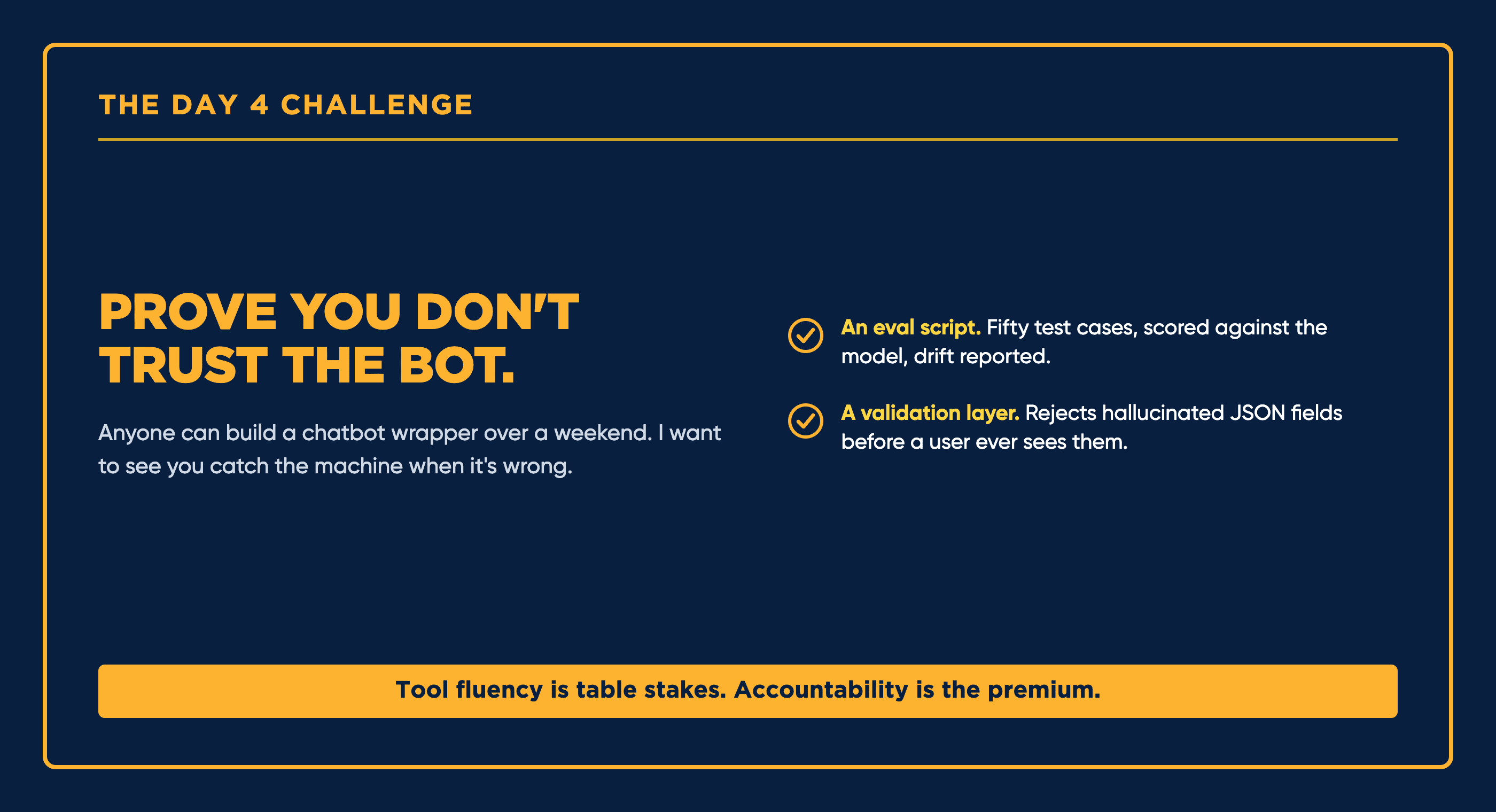
This is the highest-leverage day. Anyone can build a chatbot wrapper over a weekend, and as an engineering manager, I don't care about that. I want to see you catch the machine when it’s wrong. Build a small artifact that verifies instead of generates. Write an eval script using a tool like Google Pinpoint or the Gemini API, take 50 test cases, score the model, and report the drift. Build a validation layer that rejects hallucinated JSON fields to prove that you can be accountable for an AI's output.
Day 5: Lock down LinkedIn
Recruiters aren't the only ones searching your profile—ATS aggregators scrape LinkedIn to score keyword matches and evaluate the recency of those skills. We optimize this for the systems and the human reviewers on the other end. If your headline says "Transitioning Veteran" or "Aspiring Developer," you are invisible to both.
- Headline Formula: Target Role + Stack + Differentiator (e.g., AI Engineer | Python, FastAPI, GCP | Air Force Veteran – 8 years leading technical teams). Make sure your skills section and recent activity explicitly reflect the tools you are building with today, because recency weighting is real.
Day 6: Fix the Proof of Work
Pin exactly three repositories to your GitHub: your eval artifact from Day 4, your best full-stack project, and one that shows range. Write the README for a hiring manager who has 90 seconds. Cover what problem it solves, how it works (diagrams help), how to run it, and what you’d build next to prove you understand tradeoffs.
Day 7: Record your pitch
Record a 3-minute video walking through your best project. Explain the problem in plain language, show the decision you made, and explain the outcome. You briefed senior officers up the chain all the time, so this is the exact same rep, just about software. Do it until it’s clean.
Day 8: Contact 5 actual humans
Specificity is respect, so reach out to five people at your target companies. Don't ask to "pick their brain," ask a specific, technical question about their work that they can answer in 90 seconds.
Day 9: Prep the AI Judgment Questions
Interviews today are judgment audits, so have your answers ready:
- How do you verify AI output? (Point to your Day 4 eval harness).
- Tell me about a time the model was wrong.
- What did you decide NOT to automate?
- How would you explain this system to non-technical stakeholders?
Day 10: Set your cadence
Motivation dies, but routines don't. Set a battle rhythm you can hold for six weeks: two tailored applications, one human contacted, one hour of building, and one log entry of what you did.
The Bottom Line
The 2026 market doesn't have a shortage of people who can write Python, it has a shortage of people who can be trusted to own the output. You spent years being exactly that person, and the translation steps above make it visible.
Get your reps in, be legible by September 8th, and make the surge work for you.
Support Vets Who Code
If this resonates with you, consider supporting Vets Who Code so we can keep getting veterans into real tech roles. You can sponsor our open-source work on GitHub to back the mission. Let's get to work.